A Step Towards Sustainability: Chemical Recycling
Even from a distance, Trindade Island off Brazil’s coast is a spectacle. Soaring volcanic cliffs frame the island’s beaches and ultramarine waters where green turtles roam freely. But the water now shares its color palette with a new type of sedimentary rock: plastistones. Amalgamations of eroded plastics and sand, the rocks are like radioactive parasites encroaching on the island. The emerald stones radiate under the sun, seeping into every nook and cranny between dark volcanic rocks. They’re the result of generations of unaccounted plastic waste (Santos et al. 2022).
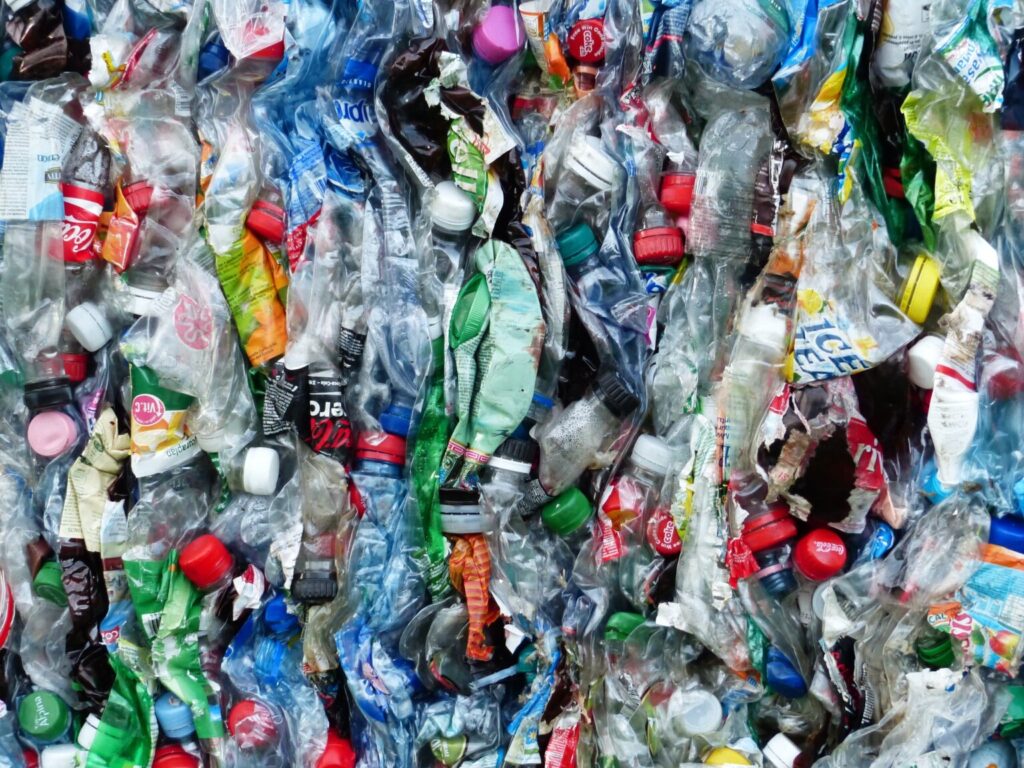
Plastic waste is a major barrier to reaching sustainability. In the US, only 5% of it is recycled and the rest – an overwhelming 95% – gets landfilled (Main 2023). Contrary to common belief, though, it’s not the fault of the public. In fact, 76% of American adults say that their local community encourages recycling (DeSilver 2016). The miniscule recycling rate results from various economic problems, ranging from high minimum wages to trade bans (Sullivan 2022). In hopes of making a sustainable future, scientists and engineers alike are pivoting to a completely new method of plastic disposal: chemical recycling.
Currently, most of the plastic that is recycled is processed mechanically (Qureshi et al. 2020). Yogurt containers and Lego bricks alike are sorted by their color and type to be ground and melted (Schyns and Shaver 2021). This process has two critical problems. First, recycled plastics are like movie sequels; they’re not as good as the original. Oxygen, heat, and moisture cause the plastic to degrade with each round of recycling (Ceretti et al. 2023). To make matters worse, remaining additives like pigments make it unsuitable for food or medical uses (Clark and Shaver 2024). This makes it impractical to use the same plastic repeatedly, so new plastic is needed. The second problem is economic – for recyclers to stay afloat, they need to turn a profit. But the high cost of labor in the US makes sorting every single plastic too costly (Sullivan 2022). This leaves recyclers with two options: landfill or export. Previously, plastic waste was shipped across the ocean in massive containers to China, where labor is cheap. This all changed with China’s 2017 ban on plastic waste imports. Although the ban benefitted China’s environment, American recyclers panicked without a place to send their leftovers (Wen et al. 2021). In the end, there was no option left but to pile them up in landfills to rot for centuries (Sullivan 2022; United Nations 2021).
Chemical recycling emerged to solve both these issues. Instead of melting down the plastics, chemical recyclers change their chemistry. One of the most popular methods is depolymerization. Contrary to the polysyllabic name, depolymerization simply means returning the material to its original form prior to becoming plastic (Khopade, Chikkali, and Barsu 2023). Because of this, it eliminates degradation. It is fairly easy for factories to use depolymerization products to produce new plastics, and the resulting material is identical to the original plastic and free of additives (Clark and Shaver 2024). This means that the next time you get your vaccine, your doctor could assure you that your syringe is made of recycled plastic – something impossible with mechanical recycling. If we opt to cease plastic productions, depolymerization products can still be used to make pharmaceuticals or dyes instead (Khopade, Chikkali, and Barsu 2023). Depolymerization works for a variety of materials ranging from PET (a.k.a plastic water bottles) and BPA-PC (in food packaging) to nylon and polyurethane (in sponges and insulation) (Clark and Shaver 2024). Its PET capabilities are particularly promising; the chemical recycler GR3N opened an industrial demonstration plant for PET in Italy last March. Although it is only a demonstration plant, it can handle almost 2,000 plastic bottles per hour and the company is planning to install a scaled-up plant that can recycle 40,000 tons annually in Spain by 2027 (Packaging Europe 2024). However, plastic depolymerization isn’t without its downfalls. In particular, it still requires plastic wastes to be sorted (Clark and Shaver 2024). There is some leeway for impurities, but it’s not much better than conventional recycling; the GR3N demonstration plant only allows for 30% impurity content (Packaging Europe 2024). It still didn’t fix the fundamental sorting problem.
That’s where the second chemical method, pyrolysis may save the day. Pyrolysis also resets plastics’ clocks but goes even further, producing fuels (Sharuddin et al. 2016). Only basic sorting is needed for pyrolysis because extruders can homogenize the plastic (Qureshi et al. 2020). Screening is still needed to prevent metal particles from damaging machinery, but that’s a big leap compared to mechanical recycling and depolymerization (Clark and Shaver 2024). What’s more, plastic pyrolysis can convert otherwise useless plastics into liquid fuel on par with diesel or gasoline, making pyrolysis particularly beneficial in countries with no natural hydrocarbon reserves (Pannucharoenwong et al. 2023). Imagine going on a road trip in a car fueled by the plastic toys your neighbor’s son got sick of. The byproducts are also useful, sent to tire manufacturers or heating facilities. But pyrolysis doesn’t make depolymerization obsolete. While pyrolysis is useful for the PP in plastic lids or for styrofoam, it can’t process plastic bottles like depolymerization does and its efficiency is also significantly lower (Clark and Shaver 2024; “Waste Plastics Recycling”, n.d.). As a result, pyrolysis is great for certain niches, while depolymerization is better for others. Like depolymerization, pyrolysis is in the early stage of commercialization with a plant with a capacity of 120,000 tons under way in Germany (Tullo 2022).
Amid the appearance of seaside plastistones, stagnant recycling rates, and economic difficulties, chemical recycling brings hope to global sustainability. Depolymerization can effectively break down plastics, with its products being used to make fresh plastics, pharmaceuticals, and more. Pyrolysis likewise promises a new source of energy, converting useless plastic waste into valuable fuel. The key to solving the decades-old plastic waste problem may therefore lie not in producing less plastic, but rather in recycling more of it.
References
Ceretti, Daniel, Mariya Edeleva, Ludwig Cardon, and Dagmar D’hooge. 2023. “Molecular Pathways for Polymer Degradation during Conventional Processing, Additive Manufacturing, and Mechanical Recycling.” Molecules 28, no. 5 (March).
Clark, Robbie, and Michael Shaver. 2024. “Depolymerization within a Circular Plastics System.” Chemical Reviews 124, no. 5 (February). https://doi.org/10.1021/acs.chemrev.3c00739.
DeSilver, Drew. 2016. “Perceptions and realities of recycling vary widely from place to place.” Pew Research Center, October 7, 2016. https://www.pewresearch.org/short-reads/2016/10/07/perceptions-and-realities-of-recycling-vary-widely-from-place-to-place/.
Khopade, Kishor, Samir Chikkali, and Nagaraju Barsu. 2023. “Metal-catalyzed plastic depolymerization.” Cell Reports Physical Science 4, no. 5 (May). https://doi.org/10.1016/j.xcrp.2023.101341.
Main, Douglas. 2023. “Think that your plastic is being recycled? Think again.” MIT Technology Review, October 12, 2023. https://www.technologyreview.com/2023/10/12/1081129/plastic-recycling-climate-change-microplastics/.
Packaging Europe. 2024. “Industrial demonstration plant to depolymerize and rebuild PET opens its doors.” March 18, 2024. https://packagingeurope.com/news/industrial-demonstration-plant-to-depolymerize-and-rebuild-pet-opens-its-doors/11101.article.
Packaging Europe. 2024. “GR3N integrates ‘first’ open automation system for advanced plastic recycling.” September 10, 2024. https://packagingeurope.com/news/gr3n-integrates-first-open-automation-system-for-advanced-plastic-recycling/11844.article.
Pannucharoenwong, Nattadon, Keyoon Duanguppama, Snunkhaem Echaroj, Chinnapat Turakarn, Kumpanat Chaiphet, and Phadungsak Rattanadecho. 2023. “Improving fuel quality from plastic bag waste pyrolysis by controlling condensation temperature.” Energy Reports 9 (September): 125-138. https://doi.org/10.1016/j.egyr.2023.05.231.
Qureshi, Muhammad S., Anja Oasmaa, Hanna Pihkola, Ivan Deviatkin, Anna Tenhunen, Juha Mannila, Hannu Minkkinen, Maija Pohjakallio, and Jutta Laine-Ylijoki. 2020. “Pyrolysis of plastic waste: Opportunities and challenges.” Journal of Analytical and Applied Pyrolysis 152 (November). https://doi.org/10.1016/j.jaap.2020.104804.
Santos, Fernanda, Giovana Diório, Carlos Ferreira, Gerson Fernandino, Paulo Giannini, Rodolfo Angulo, Maria de Souza, Maria Ferreira, and Angelo dos Santos. 2022. “Plastic debris forms: Rock analogues emerging from marine pollution.” Marine Pollution Bulletin 182 (September). https://doi.org/10.1016/j.marpolbul.2022.114031.
Schyns, Zoé, and Michael Shaver. 2021. “Mechanical Recycling of Packaging Plastics: A Review.” Macromolecular Rapid Communications 42, no. 3 (February). https://doi.org/10.1002/marc.202000415.
Sharuddin, Shafferina, Faisal Abnisa, Wan Daud, and Mohamed Aroua. 2016. “A review on pyrolysis of plastic wastes.” Energy Conversion and Management 115 (May): 308-326. https://doi.org/10.1016/j.enconman.2016.02.037.
Sullivan, Laura. 2022. “Recycling plastic is practically impossible — and the problem is getting worse.” NPR, October 24, 2022. https://www.npr.org/2022/10/24/1131131088/recycling-plastic-is-practically-impossible-and-the-problem-is-getting-worse.
Tullo, Alexander H. 2022. “Amid controversy, industry goes all in on plastics pyrolysis.” C&EN, October 10, 2022. https://cen.acs.org/environment/recycling/Amid-controversy-industry-goes-plastics-pyrolysis/100/i36.
United Nations. 2021. “In Images: Plastic is Forever.” https://www.un.org/en/exhibits/exhibit/in-images-plastic-forever.
“Waste Plastics Recycling.” n.d. Huayin. https://huayinre.com/pyrolysis-plant/waste-plastics-recycling/.
Wen, Zongguo, Yiling Xie, Muhan Chen, and Christian Dinga. 2021. “China’s plastic import ban increases prospects of environmental impact mitigation of plastic waste trade flow worldwide.” Nature Communications 425 (January). https://doi.org/10.1038/s41467-020-20741-9.